How to Get Book Signing/Selling Gigs

Standard

Sure, it’s fulfilling to see your book in print, whether it be a perfectly edited self-published copy or a traditionally published “cousin” of the thousands of other books lining the bookstore shelves!

No matter how your book is published, however, you still need to put the requisite time into marketing your book to the public. Many authors hire a professional or college kid versed social media to get the word out. They also task that professional or college kid with creating a website on WordPress, etc.

But the one marketing area authors, whether green or seasoned, shrink from playing in is this one: setting up book signing/reading/selling gigs at bookstores, libraries, senior centers, retirement communities, book clubs, literary fests, temples, churches, schools, and artist holiday boutiques!

You can definitely hire someone to do the dirty work for you — make the phone calls and send the emails necessary to book a gig. It’s more effective to actually build business relationships by contacting the people in charge of these events yourself!

In the long run, contacting these folks directly helps you, too. Think about it. You’re shelling out between $25 to $100 for a booth or table, depending on how popular the location, as well as if it’s a for-profit or non-profit venue. Wouldn’t you like to know who you’re dealing with? Who’s taking your money? Are these folks reputable?

Although the ship has already sailed for 2019 holiday gigs, come January 2020, you can start working on another time people purchase gifts for the holidays: Easter! During the month of January, spend 30-minutes per week contacting the above types of locations (You’ve probably got some not listed here. You can also Google venues near you) and set up 2 to 6 gigs, depending on your pocketbook, to display and sell your books this coming spring!

Any questions? Feel free to give me a holler through http://www.jenniespallone.com.

Happy Marketing!


Writing Outside Your Comfort Zone!

Standard

After my most recent book Smashing Castles; how a young autistic woman discovered her authentic self came out earlier this year, I’d planned to finish writing a suspense novel I started several years ago. Then there was the women’s utopia book I’d been researching. But a spark of inspiration from a personal encounter urged me to move Up Close and Personal to the front of the list.

My usual genre is psychological suspense — light on physical violence, heavy on mental manipulation — but Up Close is definitely more thriller.  I’d initially envisioned Up Close to be a fun, quirky story about a newly retired journalist who routinely embarrasses her family by asking controversial questions of strangers.

Then I met two New York literary agents at Sleuthfest 2019. After hearing my long, convoluted telling of a feel good story that eventually turns harrowing, they both urged me to write Up Close as a thrillerI protested vehemently that I don’t write James Bond; snipers, bombs, and jumping from roofs or trains to catch a bad guy just aren’t part of my repertoire.

Both agents told me that if I wanted to get traditionally published this time, I’d need to step it up. They introduced me to the domestic thriller; a style of psychological thriller that focuses on interpersonal relationships, familiar settings, and underlying causes that ignite the whole. It was then that I realized all of my novels, and even my recent book on autism, shared these characteristics.

So I took a gamble and let my writing juices fly. Since May, I’ve visited my Up Close pages five days a week, sometimes writing 1 page, sometimes writing 7. When I sit down at the computer, know what scene (chapter) I’m going to write today, and which characters are involved in that scene. But I have no clue what’s going to transpire; I attempt, sometimes more successfully than other times, to lock my super ego in the closet so I can allow the dialogue I’m hearing in my head to just flow.

And, yes, Up Close will be published through a traditional publisher — this I promise. Please help me make that happen!

Author Jennie Spallone Reflects on Opening Pages of Her Award-Winning First Mystery Novel

Standard

*Reprinted from Guest Blog, January 2017

In the bible, it says God created the heaven and earth. What a humongous contracting job it must have been to fill this unformed void, even for the all-powerful Builder of the Universe!  Should the light of day and the stars of night come first, or should the waters be divided into land and sea? Decisions, decisions, decisions!

As a writer, I am plagued with those same types of questions every time I begin writing a new novel. While my doubts don’t compromise the world’s existence, the decisions I make do determine the fate of my characters in their own universe. Should the first sentence of my book open with the setting, action, or a character’s dilemma? How do I hook the reader into continuing to read the pages that follow?  For Deadly Choices, a police procedural, I chose “action”:

“Warning lights unlit, siren silent, Ambulance Number 60 careened down fog-drenched streets in the pre-dawn autumn darkness on its return to the firehouse.” I’d recently completed a 24-hour ride-a-long with two female paramedics as they responded to emergency dispatches throughout Chicago’s dicey West Side.  I attempted to paint a picture of what it felt like to return from a call.  However, my word choice of “careened” was an image I created to fit the character of my imaginary ambulance driver, who was high on cocaine. If I had wanted to accurately describe my ride-a-long, I would have used the word “streamed,” which has a smooth, controlled connotation, while “careened” has a swerve, out-of-control, feel to it.

“Some unseen radar directed the driver as she deftly maneuvered the ghost-like rig down West Madison Street through a maze of shattered liquor bottles and discarded syringes.”  Whoa! I just realized – and this is 10 years after the book has been in print – that the ambulance driver was “deftly maneuvering,” which would negate my connotation of “careening,” the word choice I used only one sentence ago! Evidently, nobody noticed!

In this second sentence, which also happens to be the entirety of the second paragraph, I added setting and provided a “feel” of the neighborhood, with its description of “shattered liquor bottles and discarded syringes.”

My “unseen radar” and “ghost-like rig” word choices elaborated on the description of “fog-drenched streets in the pre-dawn autumn darkness” that was used in the first paragraph.

“…Replenishing supplies in the back of the rig, paramedic trainee Beth Reilly stole a glance at the driver.  She grimaced as her paramedic officer pulled a sandwich bag from her jacket….”  Again, I inserted an eye-dropper full of information I learned by watching the paramedics on my drive-along, re: what does a paramedic do en route back to the firehouse?

We now have been introduced to paramedic trainee Beth Reilly, the main character, but the word choices of “stole” and “grimaced” clue the reader that she is frightened and distressed by her paramedic officer’s actions. And what could be in that hidden sandwich bag that would produce a grimace??

“After five years as a nurse in Vietnam, followed by twelve years as a paramedic the Chicago Fire Department, Angie Ropella seemed to delight in all forms of human trauma.” From the beginning of our fourth paragraph, we’ve introduced the paramedic officer is a hard ass, trauma-junkie.

“Knuckled in-between 24-hour stints of stabbings, multi-vehicle collisions, and assaults was an assembly line of little old ladies forgetting their insulin, yuppies jogging into cardiac arrest, and winos urinating in doorways.”  Wow! I didn’t realize how many hyphens I use in my writing! Did I mention I am ADHD and easily get distracted? To complete the fourth paragraph I needed to provide the reader with visual images of the varied traumas paramedics deal with on a daily basis. Rather than listing those traumas as a journalist would do, i.e. stabbings, collisions, Diabetic reaction, I supplemented each visual image with a rhythm, i.e. “old ladies forgetting their insulin,” “yuppies jogging into cardiac arrest,” and “winos urinating in doorways.”

“After one look at the mangled body, Beth vomited all over the back seat. Angie just grinned.

“You gonna be a medic, Reilly, you can’t keep having these little accidents. Clean it up. Then keep the kid company back here. I’ll drive.”  We’ve skipped to the bottom of Page 2, where I am theoretically supposed to stop.  Earlier in the day, the two paramedics had encountered the “limp body of a kid in a motorcycle helmet sprawled across the adjoin median strip, …his body broken.” The paramedic trainee experiences a violent physical reaction. But Angie, a seasoned Viet Nam nurse and paramedic, has hardened her heart to death, as evidenced by her dispassionate advice to Beth.

“…she expertly weaved the red and white rig through a maze of congested traffic. She zigzagged around buses that suddenly jutted out in front of her onto Halsted and Clark.  Cabdrivers leaned on their horns while joggers sprinted off to work and the unencumbered meandered home from all-night bars.”  We’re almost at the end of the chapter, only 2 ½ pages  long.  The above images were taken from my ride-along experience, as well as my imagination.

Once again, these word-choices enabled me to paint pictures in my readers’ minds, as well as hear and experience the frenzied activity going on, i.e. “maze of congested traffic,” “buses…jutted out,” “cabdrivers leaned on their horns.”

I hope these brief insights encourage you to visit your favorite independent bookstore and purchase a thesaurus, the writer’s best friend. Lots more synonyms in print than on-line! Enjoy!

Reading all the Books in the World

Standard

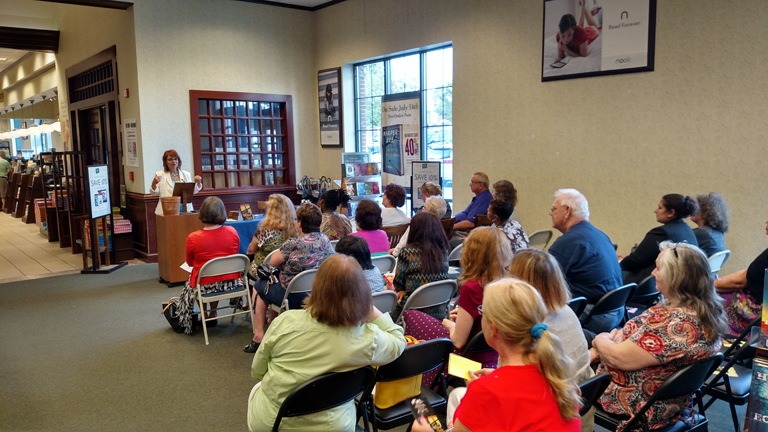
Tonight I was at Barnes & Nobles in Dearpark to support Reality Theatre’s gift wrapping fundraiser. Reality Theatre’s a great organization. They chose twenty-one teenagers from all over the Chicagoland area to improvise and perform anti-drugs, anti-drinking, and anti-smoking skits at schools throughout the area. The least I could do was support the cause.

It’s exciting to meander through a book store, dabbling in book ownership possibilities. Perusing the titles in a book store in search of a particular item is quite opposite from my goal-less adventure tonight. This time, I was just killing time. My wandering was a free and lucid journey through the recesses of my interest inventory.

I daydreamed down the psychology and children with special needs aisles, although my main interest was discovering new mystery authors, as well as authors with whom I had done booksignings at mystery conferences throughout the country.

In college, I set out to read as many new authors as possible, this in a library setting as my pocketbook was far less accomodating than my imagination. I’d pored through Ann Rand’s the Fountain Head and Atlas Shrugged and learned about the affect of pure capitalism on society from the point of view of a female architect.

Later I moved on to Theodore Dreiser, an author who wrote fascinating, introspective novels about the impact of science, economics, and chance on our humanity. After all these years, Sister Carrie sticks out in my mind. In it, the author explored a young woman’s attempt to make it in the outside world at a time when women were either homemakers or harlots.

These days, I’m lucky if I get to read two pages of a book before fading off into la-la land. I am humbled by the ambitious reading goals that held me when I was unencumbered by career or family. Yet tonight’s journey through the book store refreshed my spirit. My soul sparkles in the night, as if it just returned from a star spa.

Book Revisions

Standard

Serious authors realize that a plethora of revisions are necessary before submitting their completed manuscript to a literary agent or book publisher. While some writers dread that tedious task, others like myself savor it! It’s a real adrenalyn boost to discover the exact word or phrase that describes an emotional reaction, setting, or dialogue you wish to convey to your readers. 

The caveat in revision: Don’t devote an inordinate amount of brain cells to “fixing” the chapters you’ve already written when you should be staggering towards the finish line. In my first suspense novel, the award-winning Deadly Choices (http://www.jenniespallone.com/) , I revised each chapter each time I sat in front of the computer. Then I’d move ahead to my writing of the day.

By my third novel, I’d resolved to plug ahead until I was three-quarters of the way through the manuscript. What pain and guilt I felt in that process! Like being unable to scratch a series of mosquito bites because your hands are tied behind your back!

I did plug on, however. Window of Guilt, my third novel is almost completed. I’ll be searching for an agent or a mid-sized publisher once my “who done it” character comes clean. Yesterday, I tried to urge her on but she led me on a different course! Manna for another blog….

Even Book Authors Experience the Blues

Standard

There I was, re-editing my third suspense novel for the zillionth time, when I realized I didn’t know where to set my third to last scene. At this point in the story, my amateur sleuth is in the hospital after being attacked. She’s just been visited by her best friend as well as interviewed by a police detective. She’s about to come face to face with the one person who can unlock all the answers. However she needs a new setting for this encounter– and she can’t be recouping at home.

It’s natural for a writer to peer over the precipice and wonder what lies beneath. At times there are a vast array of choices in which to paint the setting, at other times not nearly enough. This was one of those other times. Thus, the frustration.

Share your suggestion for a setting. We’re talking straight mystery here, not fantasy, sci fi, or romance. If I use your suggestion, I’ll put you in the acknowledgement section of the book!